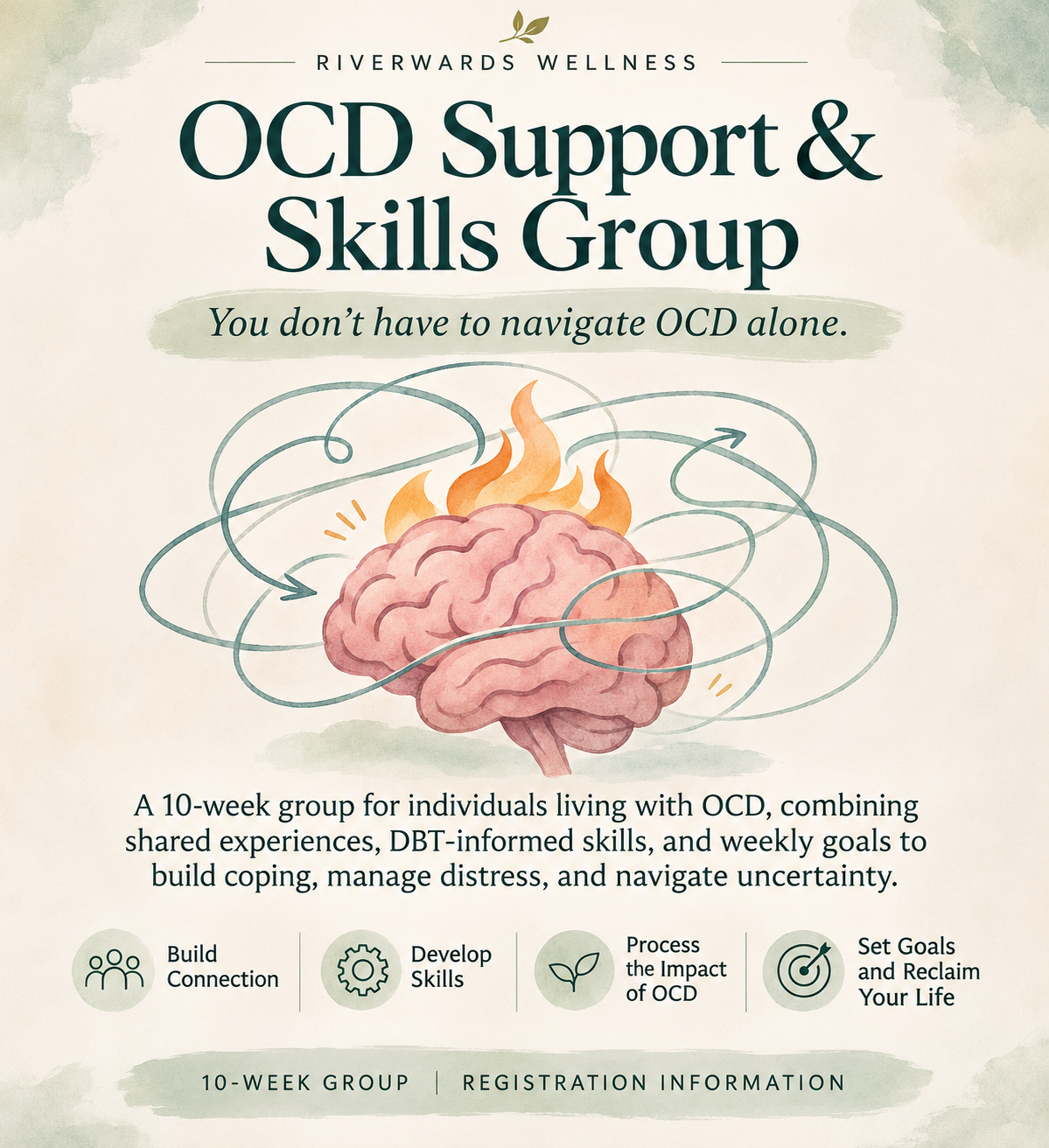
OCD Support & Skills Group
10-Week Group | Program Description and Curriculum
10-Week Group Curriculum
Week 1: Introductions, Shared Experiences, and Group Expectations
Group Processing
How is OCD impacting you individually?
How is OCD affecting your relationships?
Have you tried sharing your experiences with others? How were those experiences received?
Explore the isolation, guilt, and shame that can accompany living with OCD.
Group Development
Establish group norms, expectations, and guidelines.
Discuss the importance of validation without reassurance.
Introduce weekly goals and action steps to encourage accountability and personal growth.
Week 2: Distress Tolerance — Coping With and Coexisting With Distress
Group Processing
What makes exposure therapy so difficult?
What does the distress associated with resisting compulsions feel like?
How does overwhelming distress affect your willingness to engage in exposures or resist ritualistic behaviors?
Validate the intensity of distress associated with OCD and exposure work.
Skills Development
Introduce DBT distress tolerance skills to help members cope with and coexist with distress.
Review STOP, TIPP, Distracting, and IMPROVE the Moment.
Introduce urge surfing to help members notice and ride out compulsive urges without acting on them.
Clarify that distress tolerance is not emotional avoidance and that skills should support, rather than interfere with, exposure and response prevention.
Week 3: OCD and Relationships — Understanding the Impact
Group Processing
How does OCD affect your relationships?
Do you ever impose your OCD on others through rituals, reassurance seeking, or expectations?
How can OCD become weaponized or used to invalidate your experiences, needs, and boundaries?
Explore the difference between legitimate preferences and compulsive expectations.
Process the impact of accommodation, misunderstanding, and invalidation on relationships.
Week 4: OCD and Relationships — Communicating Needs Effectively
Group Processing
What makes communicating your needs difficult when living with OCD?
How do you distinguish between asking for support and seeking reassurance or accommodation?
How do you respond when others dismiss your needs or attribute them to OCD?
Skills Development
Introduce DBT interpersonal effectiveness skills.
Practice communicating needs, preferences, and boundaries effectively.
Explore how to express legitimate needs without imposing compulsive expectations on others.
Strengthen the ability to maintain self-respect while navigating interpersonal conflict.
Week 5: Obsessional Doubt, Values, Guilt, and Shame
Group Processing
How does obsessional doubt affect your daily life?
How does OCD create an overwhelming urge to seek certainty or relief?
Explore how OCD can co-opt personal values, creating guilt, shame, and a sense of responsibility.
Discuss how intrusive thoughts can become particularly distressing when they conflict with deeply held values.
Validate the emotional exhaustion of repeatedly questioning yourself, your intentions, or your character.
Week 6: Mindfulness — Seeing Reality Clearly Amidst Uncertainty
Skills Development
Introduce DBT mindfulness skills, emphasizing observing and describing.
Practice noticing thoughts, emotions, and internal experiences without immediately responding to them.
Learn to describe experiences without adding assumptions, interpretations, or judgments.
Explore how mindfulness can help members distinguish observable facts from obsessional doubt and interpretations.
Practice recognizing uncertainty without needing to resolve it.
Group Reflection
How does obsessional doubt influence your interpretation of situations?
What happens when you attempt to establish certainty about something that cannot be known with certainty?
How can observing and describing help you remain grounded without engaging in compulsive analysis?
Week 7: The Cost of OCD — What Have You Sacrificed?
Group Processing
What have you sacrificed in your life because of OCD?
How much time have you spent engaging in rituals or compulsive behaviors?
What places, activities, or experiences have you avoided because of fear or an inability to access your rituals?
How has OCD affected your relationships, opportunities, and quality of life?
What experiences do you wish you could reclaim?
Group Reflection
Validate the grief, frustration, and exhaustion associated with the impact of OCD.
Explore how avoidance and compulsive behaviors can gradually narrow someone's life.
Week 8: Mindfulness — Participate: Reclaiming Your Life
Group Processing
What would you like to reclaim from OCD?
How does perfectionism interfere with your ability to participate in life?
How often do you wait until you feel ready, certain, or comfortable before engaging in something meaningful?
What would it look like to engage in life without having everything figured out?
Skills Development
Introduce the DBT mindfulness Participate skill.
Practice throwing yourself fully into the moment without needing to resolve obsessional doubt.
Explore letting go of perfectionism and the need to have everything figured out.
Learn to participate in meaningful experiences while allowing intrusive thoughts, discomfort, and uncertainty to coexist.
Identify opportunities to reclaim activities or experiences that OCD has interfered with.
Week 9: Radical Acceptance — Coexisting With Uncertainty
Group Processing
What makes uncertainty so difficult to accept?
How much time and energy do you spend trying to eliminate uncertainty?
What happens when you resist the reality that some questions cannot be answered with absolute certainty?
How might accepting uncertainty change your relationship with OCD?
Skills Development
Introduce DBT radical acceptance as a way of acknowledging reality without needing to approve of it or change it.
Explore the difference between acceptance, resignation, and giving up.
Practice accepting the presence of uncertainty without attempting to resolve obsessional doubt.
Review how previously learned skills support the ability to practice radical acceptance.
Emphasize that acceptance does not require believing feared outcomes are true or guaranteeing that everything will be okay.
Week 10: Closing, Reflections, and Continued Growth
Group Processing
What has changed in your relationship with OCD over the past ten weeks?
What have you learned from hearing the experiences of other group members?
Which skills have been most helpful?
What challenges continue to exist?
What would you like to continue working toward?
Closing and Reflection
Reflect on the connections and shared experiences developed throughout the group.
Review progress toward individual goals and action steps.
Identify skills members would like to continue practicing.
Discuss how members can continue integrating skills alongside their individual OCD treatment.
Provide an opportunity for members to share final reflections and acknowledge their growth.
Recurring Group Components
Throughout the ten weeks, members will have opportunities to:
Build connection: Share experiences with others who understand the challenges of OCD.
Process experiences: Discuss the emotional, relational, and functional impact of OCD.
Develop skills: Learn and practice DBT-informed skills that complement OCD-specific treatment.
Set weekly goals: Identify realistic action steps that encourage growth and accountability.Theo Meyer
Hosted through Zoom